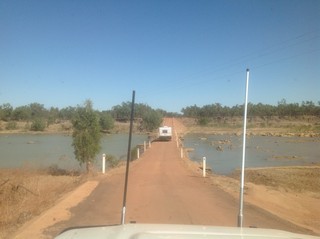
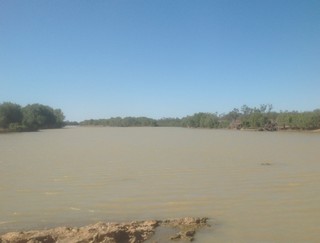
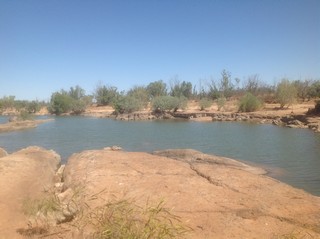
Between Georgetown and Black Bull Siding, we have to cross the Leichart River, currently the causeway is dry but there is a lot of water on the river and our first crocodile sighting (below right, spot the croc). There is a good free camping area here but it is too early for us to stop.
Tuesday 29th July
A flat tyre on the troopie awaits me this morning. No sign of anything in it and since we’re going to be in Normanton by lunchtime I can’t be bothered to repair it myself, I also have a slow puncture in one of the caravan tyres which can be fixed there too.
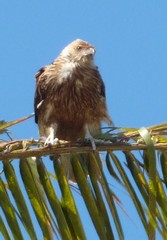
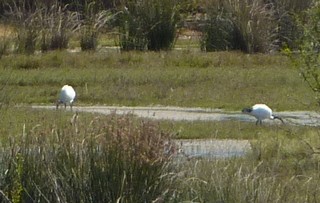
A couple of photos of local birds, Jackie, identification please?
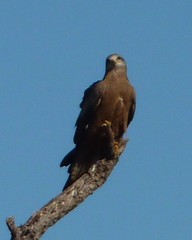
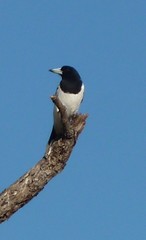
So the highlight of my afternoon is sitting around at the garage while my two tyres are being fixed and by the time I get back we decide to go for a swim in the pool and experience the hot springs. The pool is very refreshing but the hot springs spa (supplied with supposedly artesian water) is not particularly hot. A couple of hours of relaxation go down well and we’re back in time for the 5 o’clock glass or two.
Wednesday 30th July
Today we’re going for a ride on the train, or to be more precise, a rail-motor drawn railcar, from Normanton to Croydon. The line was started in 1888 and was originally planned to run from Normanton to Cloncurry but during construction there was a gold rush in Croydon and the line was diverted there. The first train ran in July 1891. It is affectionately said to go from nowhere to nowhere as it is not connected to the state rail network. The trains were hauled by steam engines until 1953 when the diesel rail motors were introduced. The original steam engine is undergoing refurbishment and will be on display in Normanton soon. The railway is run by Queensland Rail and is officially called the Gulflander or the old ‘tin hare’
We are at the station for an 0800 departure and having purchased our tickets we are able to wander around the station.
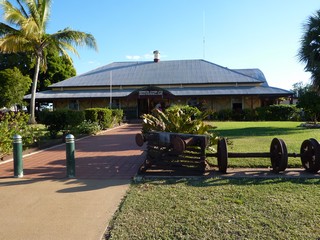
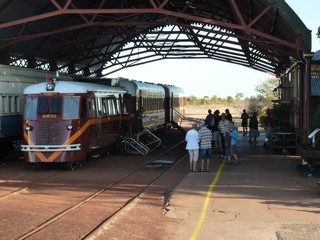
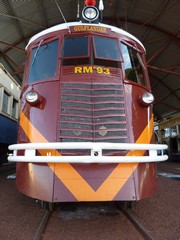
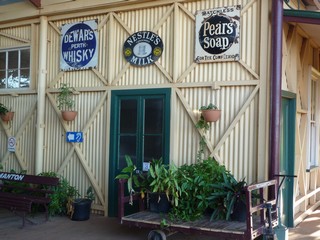
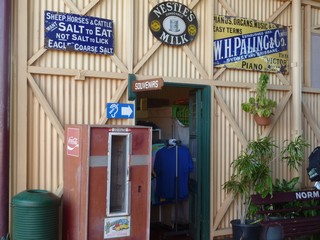
I thought this was rather neat!
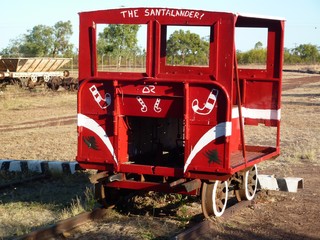
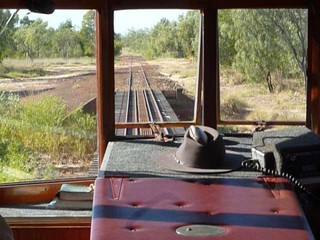
The Gulflander engine is a 6 cyl Gardner diesel which develops 102 HP at around 1200 rpm and has a maximum speed of 25 mph. The gauge is narrow at 3’6” which means lots of overhang for the carriages, resulting in a shake, rattle and roll motion! We’re sitting in the front with a view but the most comfortable seats are in the carriage behind apparently. The driver gives an excellent running commentary which is really very interesting. The drivers have to be fitters by trade so that they can deal with breakdowns on the 5 hour journey of 96 miles.
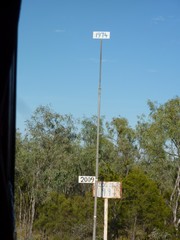
In the wet the line is often under water for months at a time, sometimes a long way under water, the flood level marker (below left) shows the 2009 and 1974 flood levels, they had to extend the pole for the latter! There a few bridges along the route, this one being the longest at about 20 metres. The track has hollow steel sleepers packed with mud to avoid the need for the usual track ballast which means the line is not subject to much damage during the wet season.
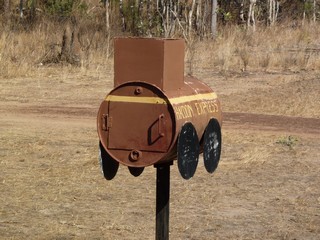
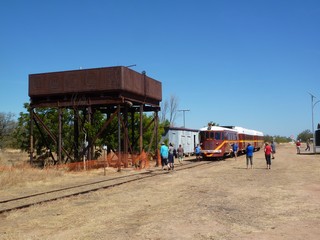
The Gulflander is still officially ‘the mail’ train and drops off mail to the stations along the route, this mail box is called the Haydon Express, Haydon being the name of the station which covers 200 square miles (128,000 acres). The morning tea stop is at Black Bull Siding where we camped on Monday night. Below right, the Gulflander at Black Bull siding, with the original water tower built for the steamers.
We eventually arrive in Croydon at 1330 ish and head straight for the pub, still shaking, rattling and rolling! A beer and a curry later, we’re in a marginally more comfortable seat on the coach, which whips us back to Normanton in an hour and a half.
Thursday 31st July
Today we’re going to Karumba, some 70 odd ks to the north and east of Normanton, which is actually on the coast and probably the only time we will get to the Gulf itself. Most of the townships along the gulf are 30 or so ks up rivers, as is Normanton, usually with nothing but wetlands between them and the ocean.
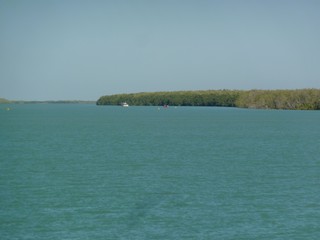
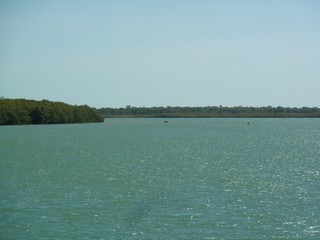
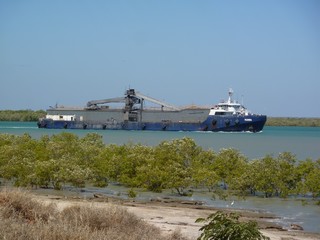
Karumba was originally established in the 1870s to service the cattle properties but it wasn’t particularly successful and sort of died out but a few years later the telegraph revived the place and it has gone on to be a fairly successful little place, mostly fishing but also cattle exports and at one time was a staging post post for the Empire flying boats on the London – Sydney route. It also has a concentrator for processing the output of the zinc mine at Lawn Hill. A 300 k pipeline brings slurry to the concentrator, the concentrate is stored in a very large shed and is then barged 45ks out to sea to be loaded onto the ore ships.
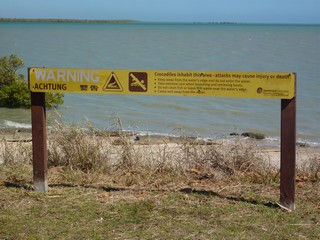
A timely warning that this is crocodile country!
Karumba has a permanent population of less than a thousand but from April – September it probably has four times this numberas it has at least five caravan parks that we could see.
We’re hoping to buy some fresh fish for the freezer as our next supermarket is about 8 days away. Up here they have huge crabs called mud crabs, which are very similar to our ‘Cromer’ crabs back in Norfolk but a darker colour. We bought a live one for our tea, knowing that we would have a problem finding something big enough to cook it in. We also buy some Barramundi a renowned local game fish which is very expensive where we live.
Lunch, fish and chips, of course, is taken at Ash’s and is very fresh and delicious – we should have only ordered one serving of chips though!
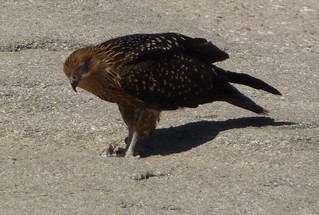
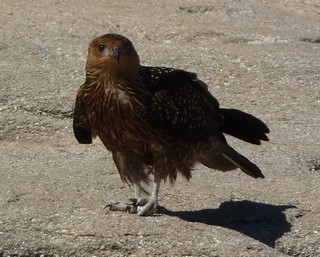
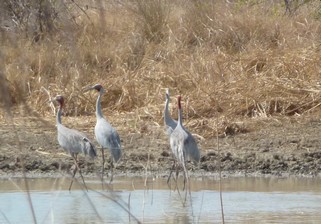
Looking around Karumba takes all of an hour but the raptors are the most prominent inhabitants, they are everywhere. This little one was so busy eating that I was able get quite close to him although his mate was screaming at him from a nearby tree. On the way back to Normanton we saw what we think are Brolgas in several of the pools/lagoons, (note they’ve got red faces).
So we head back to Normanton for a serious bit of shopping because we don’t expect to be able to shop for the next week or so.
Cooking the mud crab proved to be a tricky operation in so far as finding a suitable cooking vessel. Achieve it we did …..
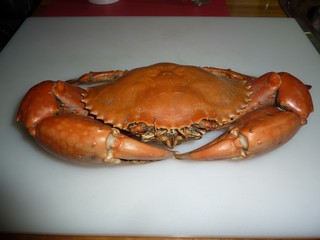 …… and very nice it was too. A very distinctive taste, probably due to the mud but also with a similar sweetness to our blue swimmers.
Friday 1st August
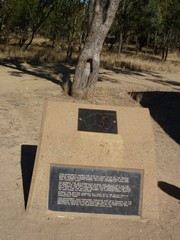
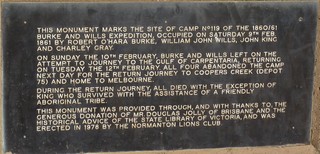
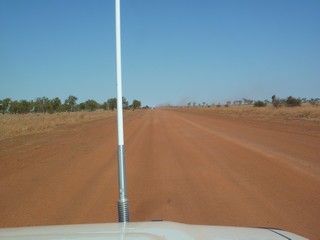
Not too much to say about today, mostly dirt road out of Normanton heading for Burketown. On the way we stop off at the Burke & Wills memorial at Camp 119. If you don’t know the story of Burke and Wills it’s worth a visit to Wikipedia but in brief they were the first people to cross the continent of Australia, leaving from Melbourne and reaching the coast at the Gulf of Carpentaria a few ks north of here. They did not survive the return journey missing their rescue party by a few hours, it’s a good read.
 The first thing you note when arriving at Burketown is an artesian bore, which was sunk some 725 metres in 1878 but which was so rich in minerals of all sorts as to be unusable for man or beast. Why they never capped it we will never know but it has been running ever since.
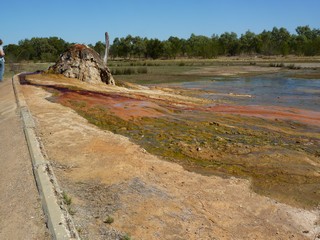
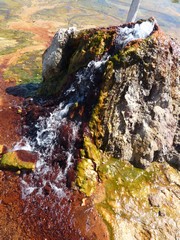
 Having driven another 500 metres we realised we were on the way out of Burketown!
We were looking for somewhere to camp tonight and ended up going to Gregory Downs, about 90 ks south of Burketown. We had looked it up and were forewarned that all the riverside spots would likely be taken – they weren’t wrong, vans everywhere and very close together, not our choice of camp site, we backtracked a bit and found a place on the other side of the bridge which suited us better and only one other van turned up, so we had a quiet night in spite of a group of our indigenous friends about 200 metres away.
Saturday 2nd August
We were going to top up our fuel tanks this morning but there was no power at the shop and therefore the pumps were out of action. We do have plenty of fuel so we head off to Lawn Hill NP which is about 70ks to the west. We’re actually camping at Adel’s Grove, about 10ks north of Lawn Hill and get there well before lunch and have time to get set up and then go out to the gorge at Lawn Hill after lunch.
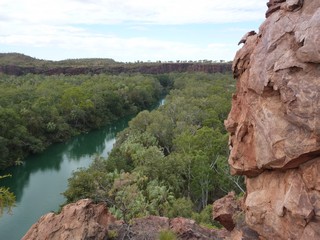
What’s the attraction of Lawn Hill? Well I’ll try to set a scene for you. Lawn Hill NP is literally hundreds of miles from anywhere. If you draw a circle radius about 500ks, from the northeast through south to north west, the scenery is the same as or similar to, that below.
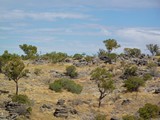
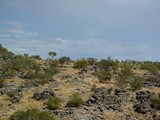
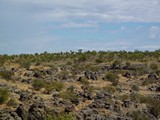
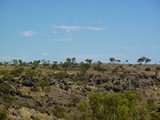
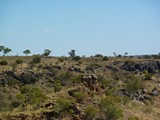
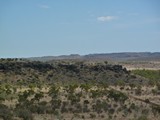
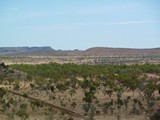
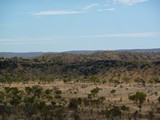
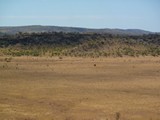
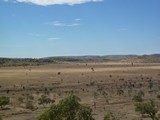
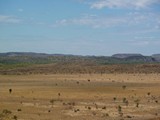
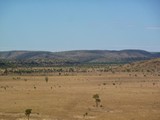
This is all arid dusty country country with little or no surface water but in the middle of all this is………
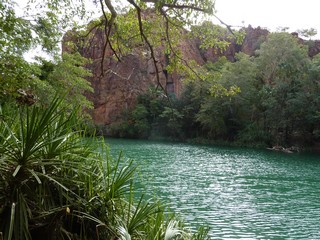
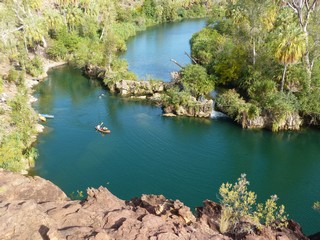
 A system of three gorges, of clear fresh, croc-free permanent water…………….the early explorers who first discovered it must have thought that all their birthdays had come at once! It is undoubtedly a beautiful and largely peaceful place, in spite of the number of visitors who make the journey here. The pictures were taken during our afternoon walk which although pretty arduous in places was worth it for the views of the gorge. A couple of the locals… we met on the way.
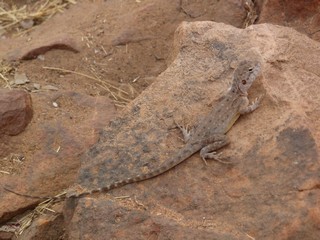
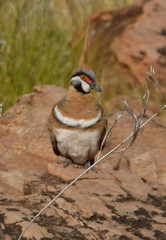
Adel’s Grove where we were staying got it’s name from a Frenchman who got a government lease on a parcel of land here with the purpose of growing and selling fruit trees, if you want to find out more about this remarkable enterprise http://en.wikipedia.org/wiki/Albert_de_Lestang . Adel‘s Grove is a contraction of Albert de Lestang.
Sunday 3rd August
50ks to the south of us is Riversleigh where there are supposed to be lots of fossils and we have decided to go and have a look at them this morning. The road is a bit rough and we come across the people who had camped near us at Gregory Downs two nights ago, on the side of the road with a shredded tyre. I asked him what tyre pressure he was running, he said 48 psi, I suggested 30 would be more appropriate, he said he agreed but that they had worn on the outside so he was running them high to get some wear out of the middle???????? Peter had noted when we met them before that the tyres were a bit worn!
Having got to the ‘fossil’ site and read the blurb we were looking forward to some exciting remains – not so. In the first instance there were very few fossils and in the second, they were not as advertised and we suspect that it was a very clever play on words. One was worthy of recording, that of the gizzard and leg bone of a large bird. From the top and side of the rock.
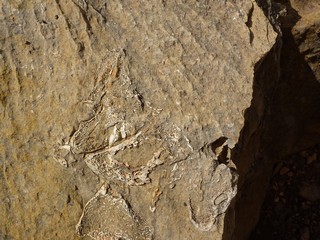
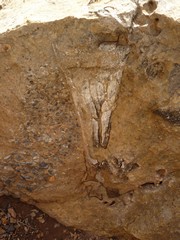
So a 100 k round trip but at least we didn’t pay $70 per person for a bus trip down there and a guided tour!
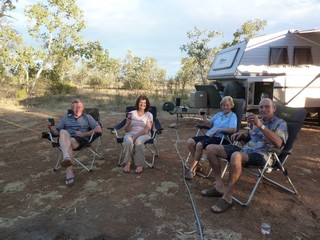
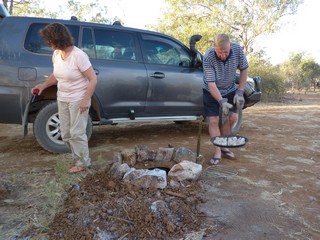
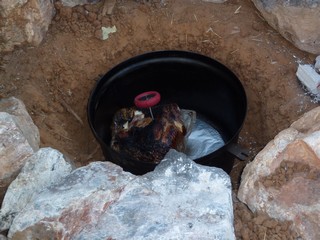
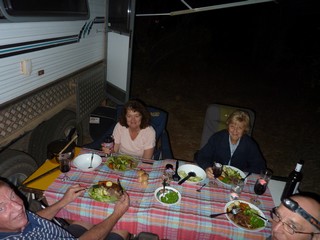
Lorraine has decided to roast a piece of lamb in their camp oven and we’re all on hand to make sure that Pete does it properly. The ‘camp oven’ is essentially an iron pot with a vegetable tray and an upside down lid on which the hot coals are placed. As always produces a tasty roast and we tuck in hungrily washing it down with a good red.
Monday 4th August
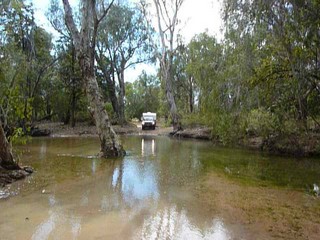
Today we’re heading back north again, initially to Domagee and then west to Booroloola. The run takes us through Lawn Hill station, a huge cattle property, the first event is a creek crossing. There is nowhere we can cross the creek at right angles and we will have to drive into the creek and along the creek bed and find a way up the opposite bank. The two key questions are; what is the bottom like and how deep is it? Fortunately we have a camper trailer in front of us and he is happy to go through first and get the answers to the questions. He disappears round the corner but quite soon lets us know that the bottom is hard and the max depth is about 800 mm. This is fine, low range, second gear and it’s no bother.
Since we’re on private property there a few gates that we have to open and close but at one gate it is being opened for us by people in a ute who are clearly station people, so we stop to say thank you and a quick chat. It turns out to be the guy who runs Lawn Hill station. He is a really nice bloke and it would have been good to talk to him for longer but there were others behind us and I guess he had work to do. I thanked him for letting travel through his property and his comment was, “well there’s 2 million acres of it, you could probably sneak through without us knowing!”.
The road traverses some beautiful country which is criss-crossed by creeks and rivers, we have several creek crossings, they all look very similar but each one has to be assessed before crossing. Some look innocuous but can be considerably deeper than they look and if the bottom is sandy it is possible to get bogged. In many places you would walk it first but not here, this is estuarine croc country!
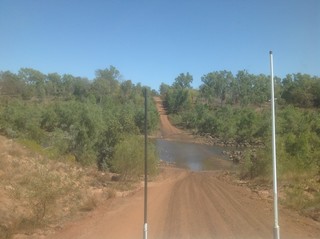
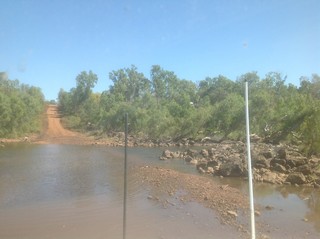
Some have quite steep entries and exits which also require consideration.
We get to Domagee just before lunch, this is an aboriginal community and they run the store where you can buy fuel, etc. Diesel is $2.04 per litre here but we top up because we’re not sure of the road conditions from here – bad roads mean poor fuel consumption. We’re not allowed to take photos of aborigines because they think that the soul is then captured by the camera!
The road deteriorates after Domagee and after a brief stop at Hell’s Gate Roadhouse
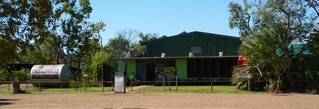
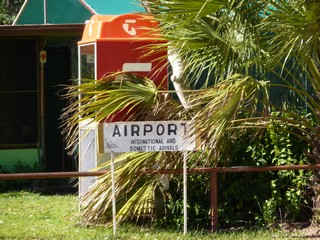
(for sale if anyone’s interested), continue along the Savannah Way, the road just gets worse – it is difficult to describe. For a start there are floodways, dips and creek beds every 4 or 500 metres, which you have to slow down to below 30kph for, so you just about get up through the gears and immediately have to slow down again. In addition, the corrugations are bad, ie; they are hard, deep and irregular. If you are just driving a vehicle you can get up to 60–80 or so and sort of float over them but towing the van it is very difficult to do that with all the floodways etc. These in particular are so hard it is spine jarring and sometimes they go for a kilometer or so before the brief respite of a few metres of smoothish track. It is tiring driving and you can’t take your eyes off the road for a second or you find yourself dropping into a washout that can only be seen shortly before you hit it!
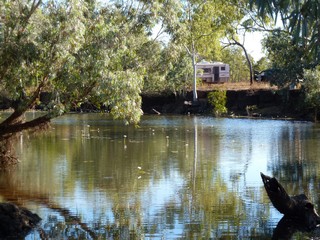
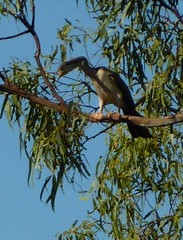
So, we are very happy to find ourselves a good spot beside a billabong for tonight, watched by a local waterbird that we have so far been unable to identify, over to you Jackie.
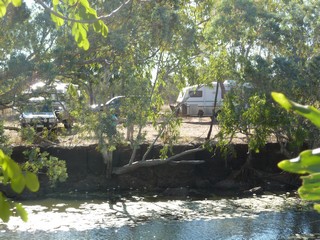
Tuesday 5th August
This morning we are faced with another pretty hard day, driving wise. The corrugations are onerous
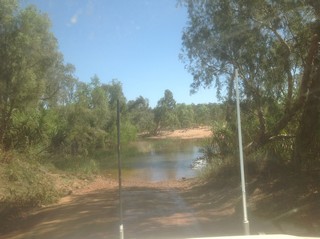
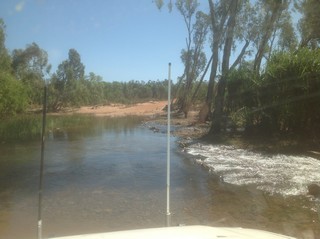
but creek crossings are good fun and we arrive at Booroloola late afternoon, in time for a shower and a glass or two of red. Actually our stocks are running a bit low but we won’t be able to buy liquor in this town – it’s dry – for the good of the locals.
Wednesday 6th August
This morning we have to go and get some shopping, no booze sadly.
All along the gulf here and in the the rivers is a mecca for fishermen, people travel vast distances across the country with their boats on trailers or on the roof of their vehicles, to come here for a bit of fishing. Some never leave, as one bloke told me , “I came for a couple of weeks 28 years ago and never left”!
Booroloola is actually about 50 ks inland so this afternoon we take a trip up to King Ash Bay (actually a bend in the MaCarthur river), where there is a camping site full of fishermen who use the boat ramps to launch their boats so that they can go down river to the mouth and the ocean. We take a drive alongside the river out to Point Batton, there are plenty of camping places along the river bank and out at the river mouth, some occupied for all of the dry season by people who return here every year.
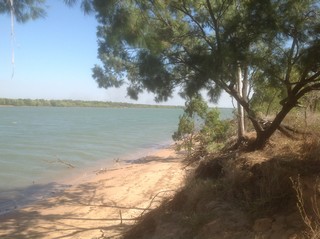
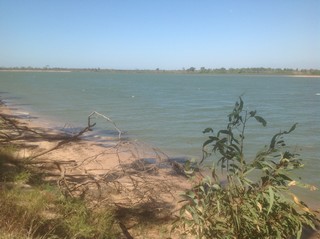
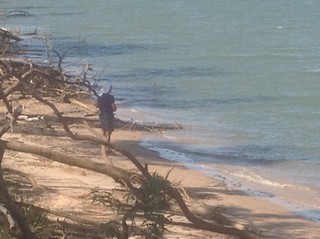
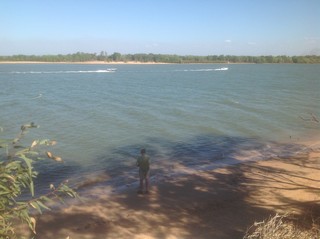
We even try our hand at fishing … without a great deal of success but I think our concentration was spoiled by the constant consideration that these waters are home to saltwater crocodiles. The girls, probably sensibly, stayed on the top of the bank!
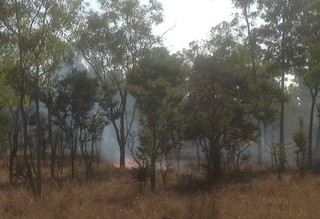
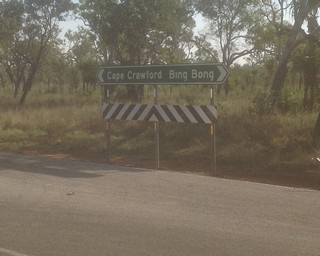
Some bush fires are burning beside the road as we return to Booroloola, we’ve seen a lot of them in the last few days and then there’s this place name ………..Avon calling!
Whilst shopping in the morning we had sussed that the aboriginal shop sold the cheapest diesel and we decided to fill up on the way back to camp. When we got back into town there were aboriginals everywhere and a few policemen and we initially wondered what what was happening but then we realised that it was ‘pay day’. This is a town where there is a large population of indigenous people who are only allowed to buy beer on ‘beer cards’ which ration them to a fixed amount of beer. The police were there to prevent queue jumpers and check that everything was above board.
Thursday 7th August
We expect that it will take us a good two days to get to Roper Bar, particularly if the road is, as predicted, as bad as the last two days. However, after an initial section, which is pretty bad, we get onto some almost reasonable tracks and make pretty good time traveling through some stunning country, to arrive at Butterfly Springs in mid’ afternoon.
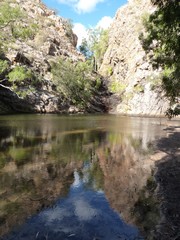
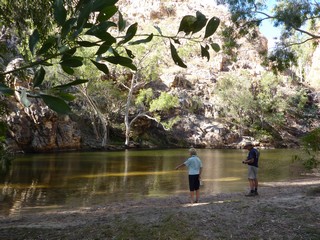
The springs are water that was retained during ‘the wet’ slowly draining from the surrounding rock formations.
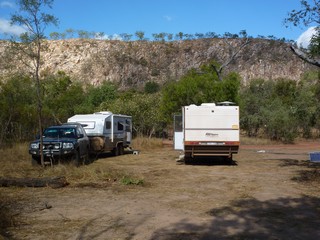
We take a leisurely look round the area, which is essentially a National Park camping ground with drop toilets. Although we are at the wrong end of the dry season, there is still enough water in the pool to make for refreshing dip, there are no crocs in this particular Spring.
There are however, water monitors……………
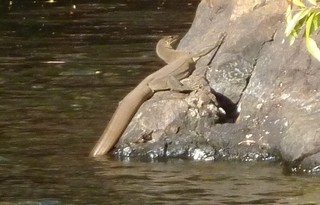
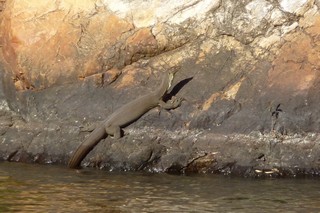
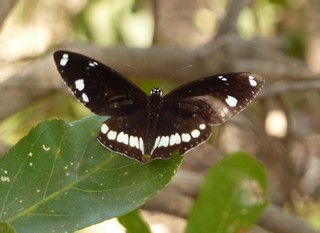
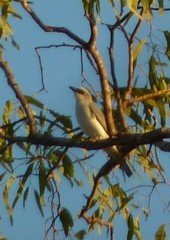
……..making the most of the afternoon sun and, it being Butterfly Springs – butterflies (for some reason with the seemingly inappropriate name of Crow!) and possibly a female kingfisher?
Friday 8th August
The road to Roper Bar lulls us into a false sense of security early on
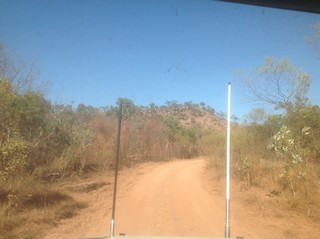
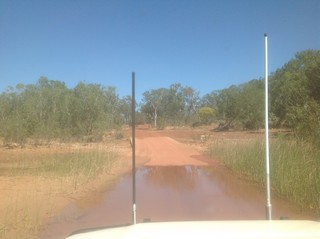
but quickly deteriorates into something worse than even the Hell’s Gate to Booroloola section and we are down to 20–39 kph for long periods. By lunchtime we have crossed a few more creeks, some dry some wet and have travelled through some of the most beautiful and awe inspiring landscapes, sadly impossible to photograph.
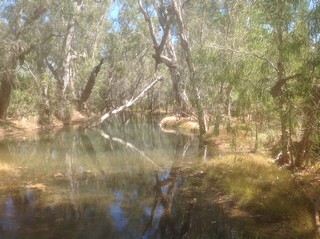
We pull into Mountain Creek camp site for lunch and then having had a look round, decide to stay here tonight. We try fishing but access to the river is limited and potentially hazardous (crocs). In any event we don’t catch anything but it was fun trying.
The Roper River at the junction with Mountain Creek.
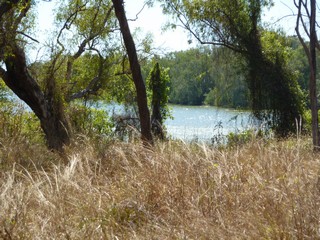
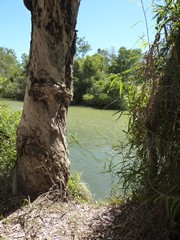
It’s difficult to describe the feeling of having the place to ourselves, sitting having a glass of wine, with the only sounds being natural ones and knowing how remote you are. Today, in around 200 ks, we have seen maybe 4 or 5 other vehicles, tonight we’re sitting outside as the sun sets, the moon rises and the stars appear, discussion revolves around ‘Big Bang’ theory and trying to get our heads round the ‘nothing’ that was here before!
Rather than open another bottle, dinner calls, the origin of the universe will wait ’til tomrrow.

