Tuesday 3 July
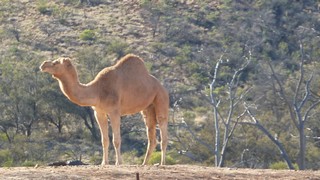
Sadly we have to leave this part of SA and the beautiful Flinders but it is on our list of places to come back to, that’s for sure. we finally saw some camels this morning, so now we’ve seen everything we ate at the Prairie Hotel!
We have to retrace our steps for about 35 ks to go round the bottom of the Gammon Ranges before turning east towards Leigh Creek and the western plains. Not too much to be said about Leigh Creek, essentially the base for the miners who work at the Leigh Creek coal mine (about 20ks further north), the town is new having been built when the old town was knocked around 1980. The camp site is clean and we stocked up on groceries (the last option for a week or so) and fuel, which will start to get expensive even we need any before Coober Pedy.
This is also the last place to pick up good drinking water for a while but when start ti fill the potable water tank, I discover that a stone has broken the outlet elbow off the tank! With some skill (and luck) I did manage to get the threaded bit out of the tank and ‘superglued’ it back together again. Unfortunately the seal on the tube end was knackered and leaked badly. So we are without a potable water tank but we have filled the three with drinking water here, which should see us to Coober Pedy where hopefully we can pick up some more!
Wednesday 4 July
Not far to go today, so no rush and it’s a leisurely run up to Marree, which is somewhere I have wanted to visit more or less since coming to Australia. In the days of the big cattle stations Marree was a very important railhead with a catchment area of around 200,000 square kilometres. Due to serious overstocking and even more seriously misunderstood land management practices, most of these big stations are long gone and with it the need for the railhead. Even so, the station remained operating until 1980. Now the main reason for coming here is that it lies at the bottom of three of the most iconic outback, the Birdsville, (520ks), Strezlecki (544ks) and Oodnadatta (607ks to Marla), tracks. These tracks were originally pioneered for moving cattle from QLD and the NT to the Marree Railhead but now have become the Holy Grail of modern travellers in their airconditioned 4WDs, GPSs and of course, off-road caravans! In the case of the first two, there is no fuel, water, food or settlements (apart from the odd station) between Marree and Birdsville or Innamincka, so they are still a good trip. We’re taking the relatively easier track to William Creek before turning off for Coober Pedy.
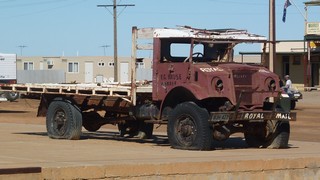
During the middle years of the 20th century a guy by the name of E G ‘Tom’ Cruise became synonymous with outback heroism. He was the ‘Mailman of the Birdsville Track’, (see the book of the same name). Essentially, he ran the mail (and anything else needed) from Marree to Birdsville. His adventures are legendary, in those days ‘the track’ was literally that, with sand dunes, creek crossing (including the Cooper, which when wet he had to ferry people and chattels across), all this without even 4WD vehicles. A film was made in around 1970 I think which is worth watching. I commend the book.
I must confess to being a bit disappointed on arriving in Marree, it is very run down and the relicts of the golden age of the railhead and the ‘Birdsville Mailman’ have not been looked after and do not reflect the importance and magic of the age. As you can see they haven’t even taken the trouble to put Tom’s amazing (read the book) truck up on blocks, very sad.
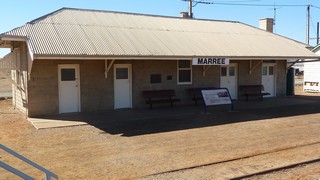
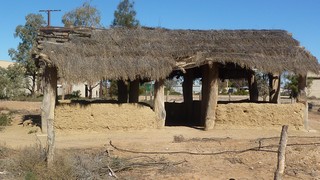 The building above is a mosque and a memorial to the Afghan camelleers that contributed hugely to the process of opening up the region and supported many of the early expeditions into the centre of the continent.
Thursday 5 July
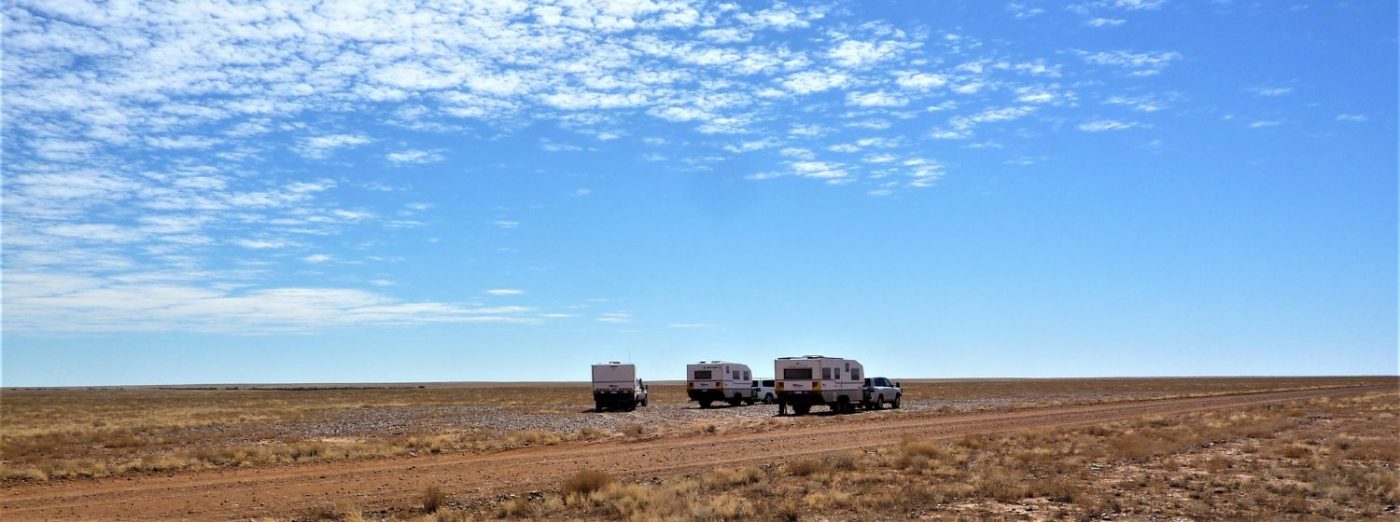
Another beautiful day, clear blue skies ……… and another short trip to Coward Springs, where we think we’ll stay tonight. The Oodnadatta Track is better than we expected
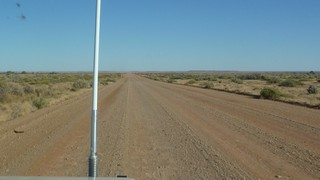 and we can travel a steady 80kph and don’t need 4WD, so fuel consumption should be good, although there are frequent ‘floodways’ or dips in the road, which you have to slow down for because one of them might just be deeper than usual and dropping into one with three and a ahalf dones behind you can seriously challenge the front end of the vehicle.
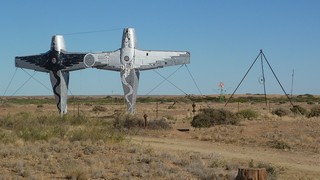
Not far out of Marree is a sort of art gallery displaying works by mechanic turned artist ????????
who has created all sorts of weird and wonderful works of ‘art’ out of junk!
The Old Ghan railway track and the Adelaide to Darwin telegraph line follows the line of the Oodnadatta track and traces of both can still be seen beside the road, like this section over a creek crossing.
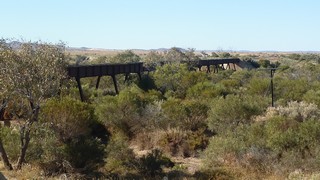
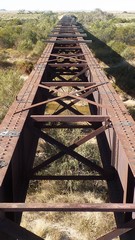 A fairly substantial structure, it all beautifully riveted and was still in use in the 1970s, though the last train left Marree in December 1980.
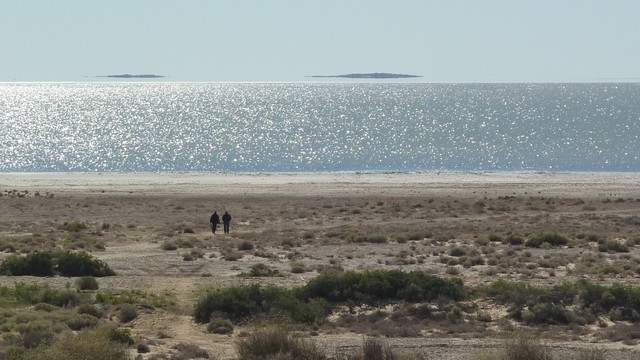
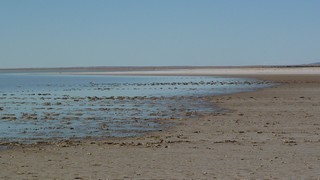
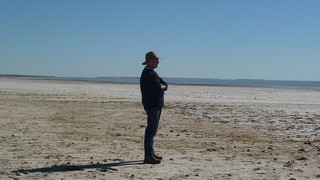
Fifty ks further on we get our first look at Lake Eyre (a key factor in the reasoning for this journey, the lake only has water in it infrequently (1974 was the last time) but in 2009 heavy rainfall in Queensland lead to the water on the west of the Great Dividing Range heading for the centre of Australia and Lake Eyre, via iconic river systems such as the Warburton and Cooper Creeks and the Diamantina. So it was a very exciting moment for us as we had the vast expanse of Lake Eyre South with the sun shimmering on the water and the islands appearing to hovering in mid air, due to the mirage, to our right as we headed up the track to the access point. Here we could actually walk down to the lake itself. Being a salt lake it though the edge is very soft with horrible brown mud just below the surface. Nevertheless, we were just blown away by actually being here. We hope to take a flight over the lake from William Creek when we get there in a couple of days time.
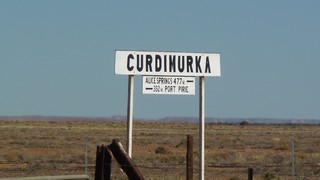
There were sidings at intervals and one of these at Curdimurka has been preserved.
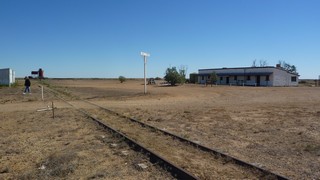
These sidings had a Station Master though how he occupied his time is uncertain as his house was often the only building for a hundred ks in each direction!
A more populated siding was Coward Springs, which at one stage had an engine driver’s cabin and a pub! The Engine Driver’s Cabin has been restored to it’s original condition and is used as a museum, full of fascinating stories of the siding in the last quarter of the 19th century and first half of the 20th.
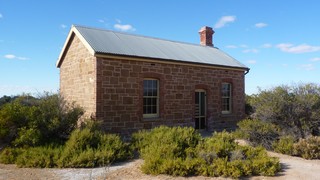
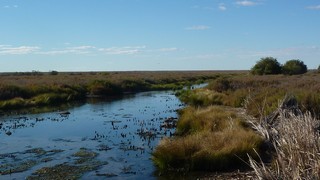
Coward Springs main attraction to visitors however, is a ‘hot’ (really tepid) spring fed from the underground water of the Great Artesian Basin (GAB) (which has created an oasis in the desert and literally dozens of visitors arrive here everyday, either to jump in and drive off, or just take a look. The tragedy is that the GAB was an unbelievably massive reservoir of water but the bores (drilled to supply water for the cattle, in many cases were never capped, so they have just been releasing water to waste in the desert, in some cases for a hundred years, As a result the water is now very salty in lots of areas.
Friday 6 July
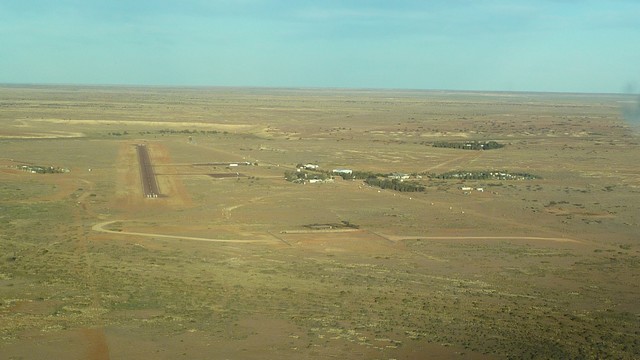
Last night we stopped at Coward Springs and this morning have had a very short trip 70 ks to William Creek, another iconic Australian, location, boasting to be the smallest town in the country, with a permanent population of 10!
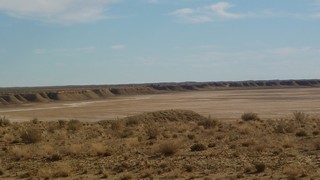
On the way we pass through what is called in SW QLD ‘jump up’ country, with flat topped mesas formed by glaciation.
How it got ‘town’ status in the first place is difficult to determine, particularly as at its height it seems only to have had around 200 inhabitants but hey! The ‘town’ was a stop on the Old Ghan Railway and the pub was well patronised by travellers and railway workers, the beginning of the end came when a ‘dining car’ was added to the Ghan!
Our main reason for stopping here is to take a flight over Lake Eyre, which was the focal point of the trip. We did the trip this afternoon, taking off around 1600 and flying over the lake and its surrounding countryside for an hour. The lake itself is probably only 30% full at the moment but it doesn’t really matter, it’s the context that makes this flight important. The lake is vast, some 9,000 square kilometres, so even from 2500′ you cannot get a complete picture. The view is almost impossible to describe, certainly for my limited descriptive capabilities and the camera cannot give the complete picture, suffice to say that we were really taken with the beauty of it all.
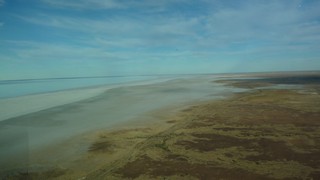
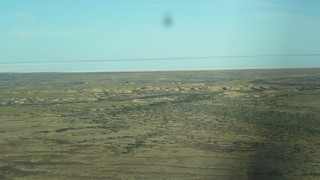
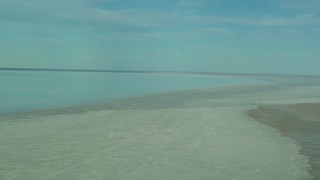
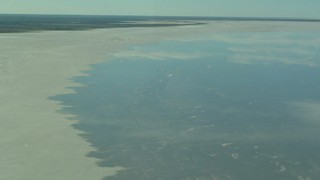
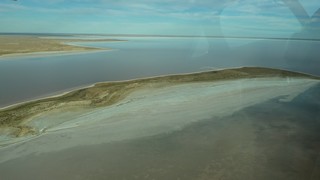
From the air the vastness of this country is emphasised, from 2500′ it is 360 deg of featureless desert and William Creek itself is just there ……………