Saturday 7 July
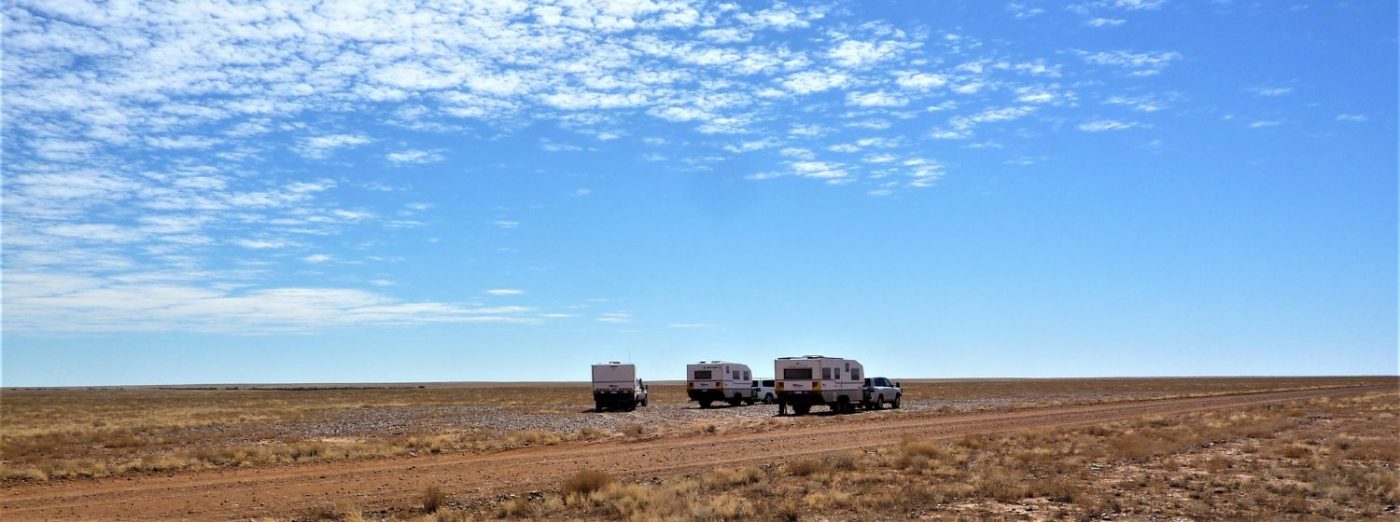
The first 80 or so ks from William Creek to Coober Pedy were pretty rough, not only was it corrugated but it had floodways every five minutes, so there was no time to get up to speed and over the top of the corrugations before having to slow down again, not only is this hard work but the fuel consumption goes up too.
Eventually, we get onto some good stuff and the next 60 ks into Coober Pedy is smooth by comparison.
Coobery Pedy began life in 1915 when a gold prospecting team were working about 15ks to the south east of what is now Coober Pedy (originally Stuart Range Opal Mine), supposedly tanslated from the aboriginal for ‘white man in hole’. The men went out to search for water for which they were desperate and left 14 year old William Hutchinson to look after the camp, a task he soon got bored with and went of for a look round. He not only found water which the others hadn’t but he also picked up a chunk of opal ……………the rest of course, is history!
At one time CP boasted a population of 4500 but this is reputed to be down to around 2000 now. Mining these day is carried out using machinery such as cutting machines, at the face and blowers to suck up the debris and deposit it in piles.
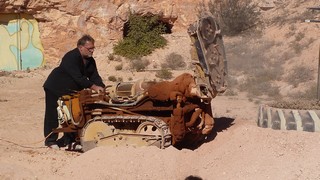
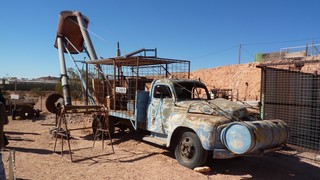
Believe it or not these machines actually work!
In earlier times the miners had to dig their own shafts (made to measure for the miner, approx 12′ per day), until they hit the layer of opal, then they would tunnel off following the level, using a pick, the waste being hauled to the surface in cowhide buckets.
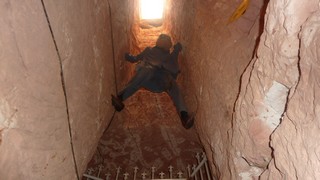
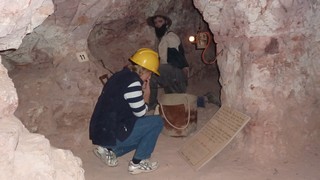
There is no way of detecting opal other than digging for it, so there were many fruitless holes.
Approximately 50% of the population of CP live underground in ‘dugouts’, often these are the front end of the mine itself and there are many stories of major finds as the result of ‘extending the home (eg; digging another bedroom!).
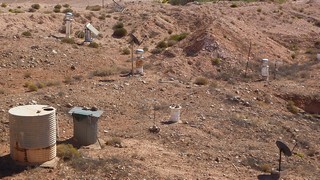
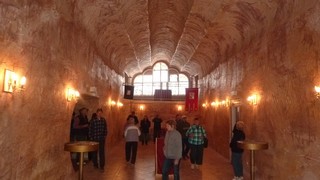
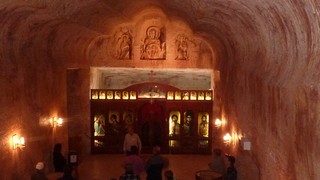
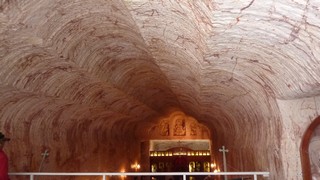
There are four churches in CP, all are underground, this one is rather elaborate, the roof pattern is the result of using one of the cutting machines above.
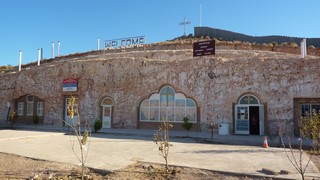
These days exploration is relatively easy, using a ‘Caldwell Drill’, this machine cores a hole a metre diameter, up to 30 metres deep, the idea being that you monitor what comes up and if it has opal in it you can decide where to open up your mine. Mining leases can be 50 x 50, or 50 x 100 metres, so the result of all the drilling produces these curious cone shaped mounds over thousands of square kilometres.
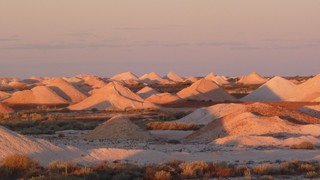
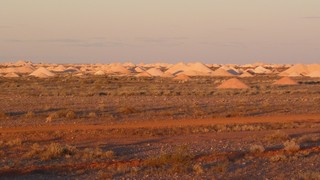
There is a law ‘against’ filling in the core holes (for safety reasons!) so the entire area is lethal with literally hundreds of thousands of 1 metre diameter by 30 metre deep unmarked holes!
Thirty or so ks to the north of CP is the Dingo Fence, 5500 ks long staring on the Surfers Paradise, QLD reaching the south coast of near Ceduna, designed to keep dingoes in the cattle country to the north and out of the sheep country to the south.
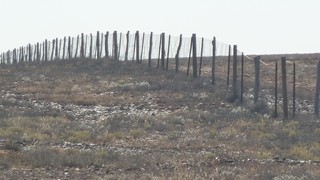 Each station that the fence runs through is responsible for the maintenance of the fence on their station.
A bit further along the track are the ‘Breakaways’ a range of hills which change colour fairly spectacularly as the sun moves during the day. Again we thought that they were quite impressive but unfortunately the camera doesn’t do them justice.
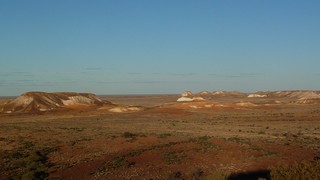
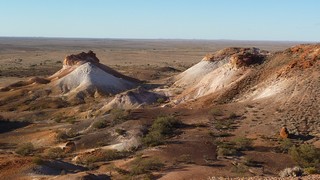
We enjoyed Coober Pedy.
Today Wednesday 11 July we left Coober Pedy heading north on the Stuart Hwy (Adelaide to Darwin), it was good to be on the tar for a change but with a bit of a headwind the fuel consumptin was a bit higher than usual. After 160 ks we turned back onto the the dirt to go and visit The Painted Desert 90 ks away. The road was pretty bad, very rutted, with sections of very loose stuff, all of which made driving hard work.
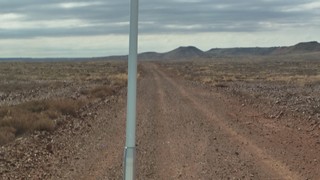
When we got there we decided that it was not as good or extensive as the Breakaways, documented above.
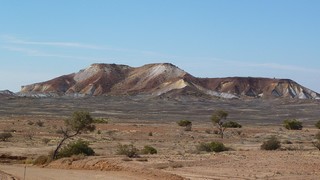
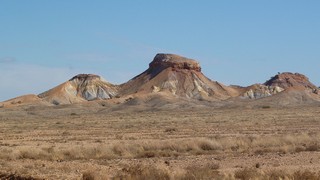
We had planned to bush camp out here but the wind decided us to retrace our steps to the Hwy. We made good time getting back and then, in spite of the wind, go progress up the Hwy and we ended up at Marla, about 180 ks further on than we anticipated, which means we can have a couple of easy days into the Ayers Rock NP.
We met a couple from QLD who had sold up and been on the road for a year. They were doing a bit of work here and there to supplement their income and thoroughly enjoying themselves.
Thursday 12 July
In no hurry we had an easy start to the day and eventually set off up the Hwy again in the direction of Alice Springs (550 ks). All there is to do is sit and watch the scenery go by and marvel at the vastness of this land. We often do crosswords, the passenger reading out the clues, this morning we did the Telegraph in about 30 km! A break occurs when a road train (a prime mover plus three trailers 56m long comes up behind) we talk to them on the radio, to let them know that we know they are there and tell them that when they want to overtake we will drop back if necessary to let them in, they will tell us when they’re coming through and then we tell them when they are clear to come back onto the left lane. This sounds like fun but in fact it can sometimes take them a kilometre to get past. It’s not so bad on the Hwy in the Northern Territory because they can do 130 kph, so provided we don’t hold them up they can usually pass without problems.
At Erldunda Roadhouse we turn left and are heading west for the first time in weeks, only about 1800 ks from home!! We pass the road to Kings Canyon but will give it a miss this time as we expect to be this way again next year. On the way we pass Mt Conner which is pretty impressive in its own right but is unfortunately overshadowed by Ayers Rock.
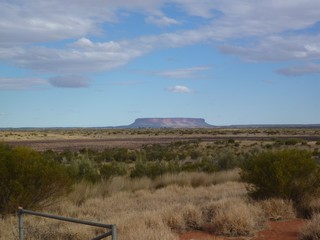
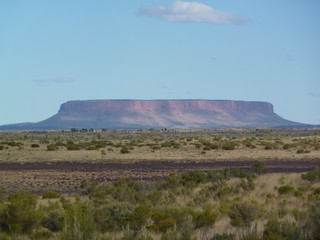
We decided to stay tonight at Curtin Springs a Roadhouse 85 ks short of Yalara, the hopping off point for the ‘rock’.
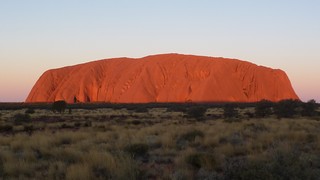
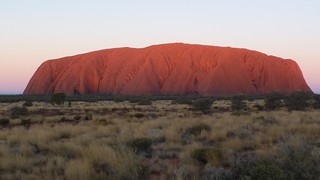
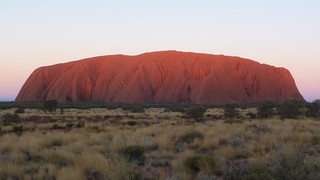
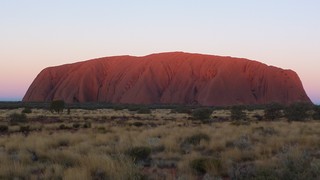
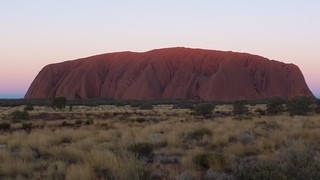
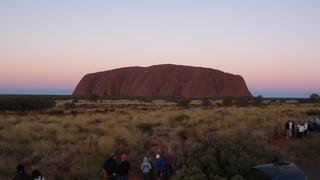
So today, Friday 13 July we catch our first sight of Uluru as we approach Yulara, we decide to visit the visitors centre at the rock before we do anything else.
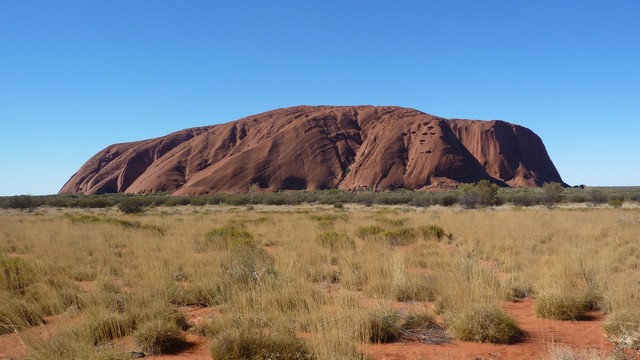
We have decided that we will stay here for a few days before heading west into the deserts. So we have plenty of time to see sunrises and sunsets at the rock and
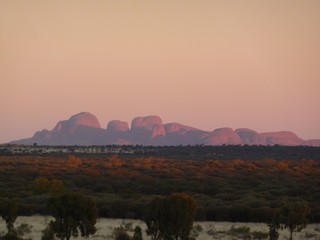
The Olgas, ‘many heads’ as translated from the local aboriginal tribe (the Anangu), language. Here is a selection of shots at various times of the day. Uluru and Kata Tjuta (The Olga’s) are basically ironstone (I think this is sandstone with iron in it, which accounts for the red colouration).
A visit to the Olga’s at the western end of the NP…..
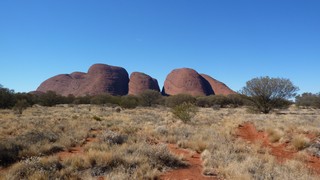
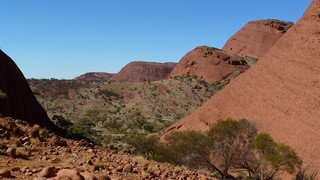
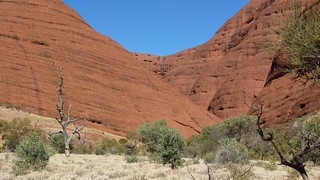
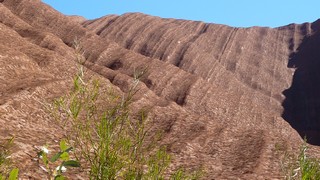
Pat’s birthday, up at 0600 ………………………………..
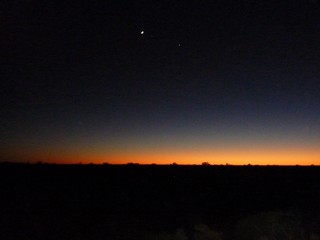
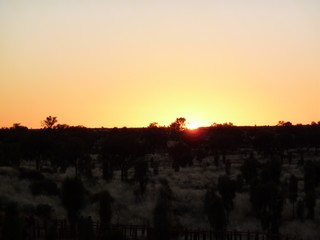
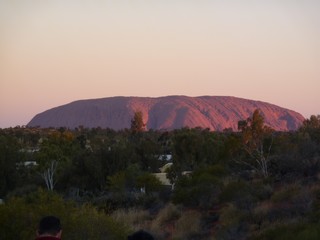
Monday 16 July
A day of checks and preparation. On my list a check of the suspension on the caravan, to my surprise one of the suspension pads was worn to limits and in fact, beyond!
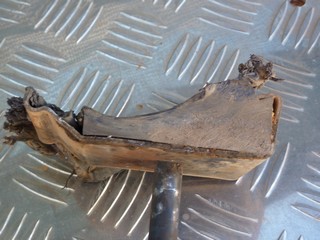 So it was case of jacking up the caravan, dropping the spring and replacing the pad.
The rest of the day was getting washing done, re-packing the cruiser, topping up all the tanks, water, diesel and petrol (for the generator) with Opal, a special fuel that you are required to use when entering aboriginal lands because the locals can’t sniff it!
Met some people this morning who also have a Bushtracker and who by shear coincidence are heading in the same direction as us and on the same day, so we will at least know someone else is out there and not far away.
We are off to the rock to watch the sun go down…………….


Hi Pat + Roger
Just read your latest report. We liked your pictures, which reminded us of our visit to the then Ayers Rock many years ago! Although we travelled by air and coach. We have also used the tracking log and found you on (or just off the Great Central road) past Docker Creek.
Belated Happy Birthday Pat, keep the reports coming. Love from Peter Janne Christopher + Jennifer.